
Photo by author: nothing beats an embrace with those we love. Malta, 2026
A few months ago, one of my best friends came face to face with herself.
Not the version of herself she presented to the world — the fun one, the social one, the one always up for a night out. The other version. The one that had been quietly drowning for a long time, the one that finally surfaced in the form of a severe addiction and a life that had collapsed from the inside out.
It happens like that, sometimes. The outside looks like a party. The inside is something else entirely.
And her boyfriend of four years — this seemingly solid, successful, lovely-on-paper man — what did he do when she needed him most?
He disappeared. No conversation. No confrontation. Just radio silence, avoidance, and then nothing.
Good riddance, honestly.
Because here’s the thing my mom drilled into me from a young age, and the older I get, the more I know it to be true: your true character comes out in crisis.
Not your best day. Not your highlight reel. Not the version of you that shows up when the sea is calm and the sun is out and everything is easy. The crisis is where you find out who someone actually is — including yourself.
Crisis Is a Filter — For the People Around You
When everything falls apart, you don’t need to do much investigating. The people in your life will sort themselves out for you.
Some will run. Tail between their legs, just like my friend’s boyfriend, unable to sit in discomfort that isn’t their own, incapable of staying when staying requires something real. These are the people who were never actually there to begin with. The crisis just clarifies what was already true.
Some will crumple. They mean well, but the weight of the situation breaks them too. They’re drowning alongside you, which leaves you holding two people instead of one.
Some will fight. Gloves on, energy up, rallying every resource in your direction. I know this one intimately — it’s my mom. The biggest mama bear you’ve ever encountered in your life. The woman doesn’t flinch. She doesn’t hesitate. She just moves, whatever needs to be done, whoever needs protecting, she is already there doing it. Watching her shaped everything I believe about who you want in your corner.
Some will protect. They won’t necessarily fix anything, but they’ll hold space, so that you don’t have to face it entirely alone.
And some will disassociate. Compartmentalize, go surface-level, push the hard stuff into a corner, keep things light because heavy is too much for them to hold.
The crisis doesn’t create these tendencies, it just strips away everything that was covering them.
The crisis filters your circle for you. Let it.
I learned this in the most visceral way eight years ago, when my father went missing in Thailand.
For weeks, while we searched, my inbox filled with messages from his brothers and sisters. Sending love. Thinking of you. Let us know how we can help. The kind of words that feel warm until you actually need something.
Then we found him. In a Thai prison.
Photocred: @engineakyurk
I booked the flight the same day.
When I landed in Bangkok, the heat hit like a wall the moment I stepped outside the terminal — thick, heavy, unrelenting. I remember sitting in the back of a cab watching the city blur past, trying to hold myself together long enough to do what needed to be done.
The prison cell was a cement block with no windows. Overcrowded so severely that there wasn’t enough floor space for everyone to sit down at once, let alone sleep, so fistfights broke out regularly, just for a patch of ground. My father was the only foreigner there. He got two meals a day: white rice. There was a bucket in the corner that everyone shared as a toilet.
When they brought him out, I didn’t recognize him.
He was six feet tall and weighed a hundred pounds. Barefoot. His orange jumpsuit was soiled. He hadn’t shaved in months, and his gray hair had grown down to his chin. There were pussy, infected cuts and gashes across his face, his head, and his arms.
But it was his eyes that did it.
That’s the image I can’t shake. Vacant. Completely gone. Like whatever light had lived behind them had packed up and left.
I was so relieved to find him. But in reality, there was nobody there to find.
I got him on a plane. He slept most of the flight. I sat beside him and stared at nothing, trying to process the fact that I may have gotten my father’s body back but not my father.
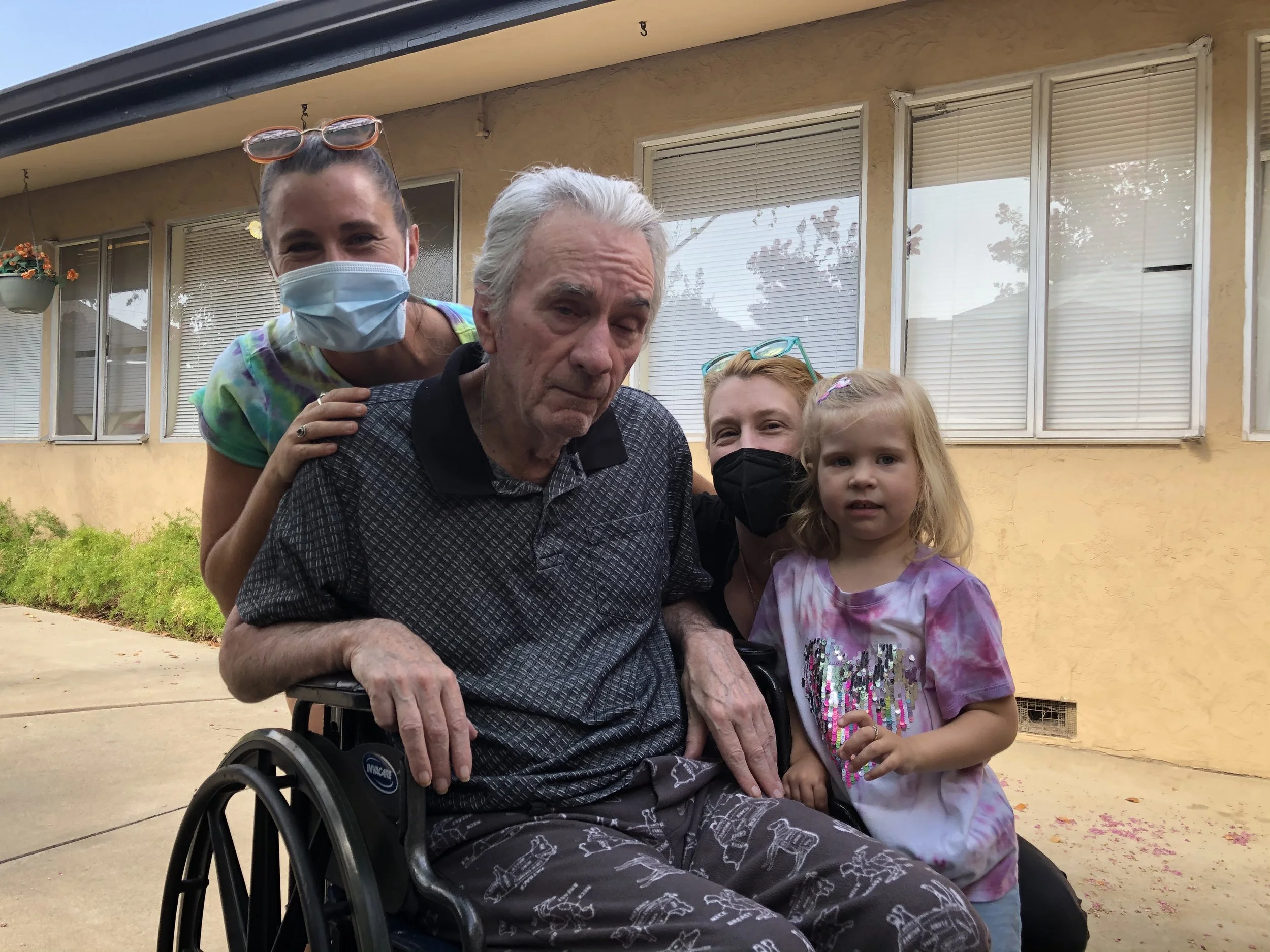
Photo by author: My sister, her daughter and I spending time with what was left of our father, 2021
Back home, the reality set in quickly: he had nowhere to go. No stable place, no plan. So I did what felt obvious — I reached out to his family. The same brothers and sisters who had spent weeks flooding my inbox. Sending love. Thinking of you. Let us know how we can help.
I let them know.
I asked if he could stay somewhere, just for a few nights.
Radio silence. Or: we’re busy.
Every single one of them.
That was the end of those relationships for me. Not out of bitterness, out of clarity. The crisis had done me the favor of showing me exactly who they were, and I believed them.
I made a decision that day, one I’d make again without hesitation: I’m done investing in people who can only show up when it’s easy. Life is too short for surface-level relationships, and life has proved to me, repeatedly, that things will go wrong. When they do, I want people around me who stay. Who actually show up when the ask is real.
The crisis filters your circle for you. Let it.
But Crisis Also Reveals You — To Yourself
Photocred: @laurachouette
Here’s where it gets more personal.
Because while it’s easy to look at my aunt, uncles and friend’s boyfriend and see a coward (and I do), let’s be real, the harder question is the one we have to turn inward.
Who are you when things fall apart?
There’s a phrase I keep coming back to: you’re only as good as your worst day.
Not the day everything goes your way. Not the win or the celebration. What you’re made of shows up in the day the system crashes, the relationship fractures, the diagnosis lands. The day you have every excuse in the world to fall apart — and you don’t. Or the day you do fall apart, and you face that too.
The Stoics understood this better than most. Epictetus, who was born a slave and knew something real about circumstances he couldn’t control, argued that the only thing ever truly ours is our response. Not the event. Not the outcome. Not the other person’s behavior.
The response is yours. Entirely.
Your reaction when you’re passed over for the opportunity. How you show up when the relationship is struggling. Whether you panic or adapt when everything collapses. These aren’t just moments, they’re the actual substance of your character, which is both a sobering and a strangely freeing idea.
Because if the crisis reveals you, it also gives you something. It tells you who you actually are when the performance drops away. And if you don’t like what you see? Good. Now you know what to work on.
Calm Doesn’t Prove Anything
We’re wired to celebrate ease. We applaud the winner, the smooth talker, the person who’s never visibly rattled. But calm isn’t a virtue — it’s just the absence of difficulty. Anyone can steer the ship when the sea is flat.
The real question is what happens when the storm hits.
Nobody remembers Lincoln for the quiet years. They remember him holding a fracturing nation together through a civil war, governing through grief so profound, and refusing to abandon a vision of unity when everyone around him was choosing sides. Nelson Mandela spent twenty-seven years in a prison cell and walked out without bitterness — not because nothing had been done to him, but because he had decided who he was going to be regardless. Malala Yousafzai was shot in the head for going to school and came back louder.
These aren’t people who had it easy and performed well. They’re people who were tested at the absolute limit and didn’t collapse.
You don’t have to lead a nation for this to apply. Think about the people in your own life you trust most. The ones you’d actually call at 2am. I’d bet every single one of them has shown you something in a hard moment — not just in the good ones. That’s not coincidence. That’s character.
Who Do You Want to Be?
Your worst day is a mirror. It reflects back more honestly than any perfect, easy day ever could.
And I think a lot of us are, to some degree, wired toward a particular way of responding to hardship. Some of it is temperament. Some of it is what we watched growing up — the model we absorbed before we were old enough to question it.
But I also believe that people can change. That we can work toward becoming the person we want to be in the storm, rather than defaulting to old patterns. That’s not naive optimism, that’s what growth actually looks like.
You can’t plan for everything that will go wrong. You cannot control what happens. What you can do is work on your values — the principles that become your compass when the compass is the only thing you have left. You can practice being a little less reactive, a little more present, a little steadier in the small crises, so that when the big ones come, you already know something about who you are under pressure.
So here’s where I land, after all of it: the crisis is the filter — for the people around you, and for yourself. The question isn’t whether hard things will come. They will. They always do.
The question is who you’ll be when they do.
And who you’ll have standing beside you.
